

How Advanced Battery Management Systems Improve AGV Safety, Charging Efficiency, Runtime, and Operational Reliability in Modern Warehouses and Smart Factories
Why AGV Batteries Need an Intelligent Management System
Automated Guided Vehicles (AGVs) have become an essential part of modern material handling. From manufacturing facilities and distribution centers to automated warehouses, AGVs transport materials, move components between production lines, and support increasingly sophisticated logistics operations. As these vehicles become more intelligent and operate for longer hours, the reliability of their battery systems has become a critical factor in overall equipment performance.
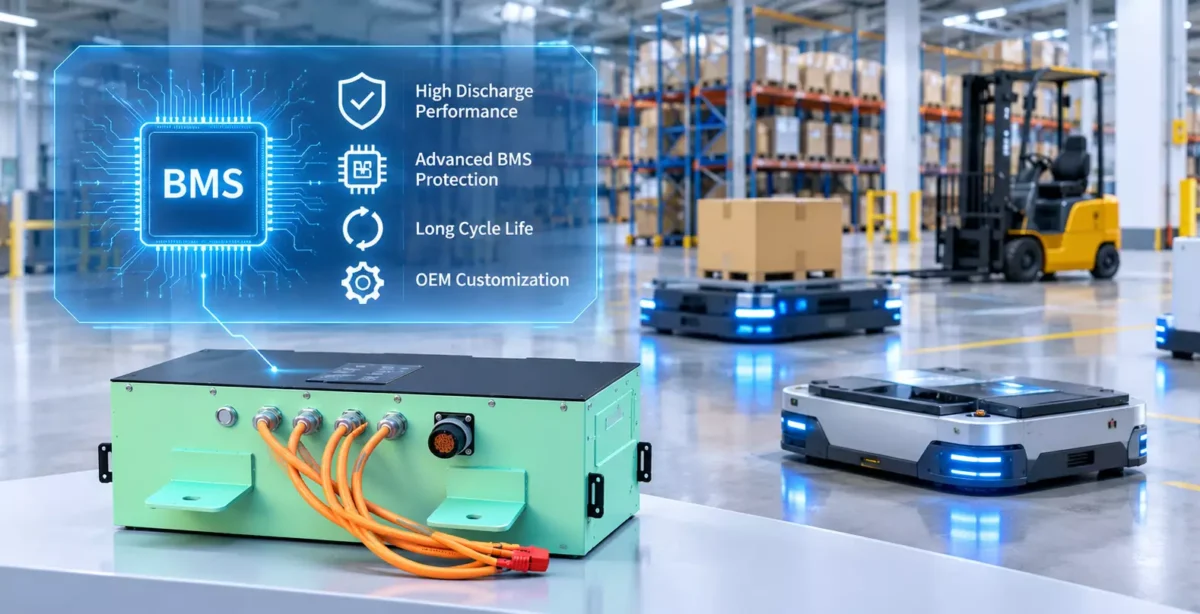
At the heart of every reliable lithium battery system is a Battery Management System (BMS). Often described as the brain of a lithium battery, the BMS monitors battery conditions, manages charging and discharging, protects individual cells, and communicates with the vehicle’s control system.
For AGVs, however, the role of a BMS extends beyond basic battery protection. It directly affects charging schedules, fleet availability, energy utilization, and maintenance planning. A well-designed BMS helps ensure that an AGV receives the power it needs while keeping the battery within safe operating limits.
Understanding how a BMS works is therefore essential for AGV manufacturers, system integrators, and warehouse operators looking to build efficient and dependable automated material-handling systems.
1. What Is a BMS Battery Management System?
A Battery Management System is an electronic control system designed to monitor, protect, and manage rechargeable battery packs.
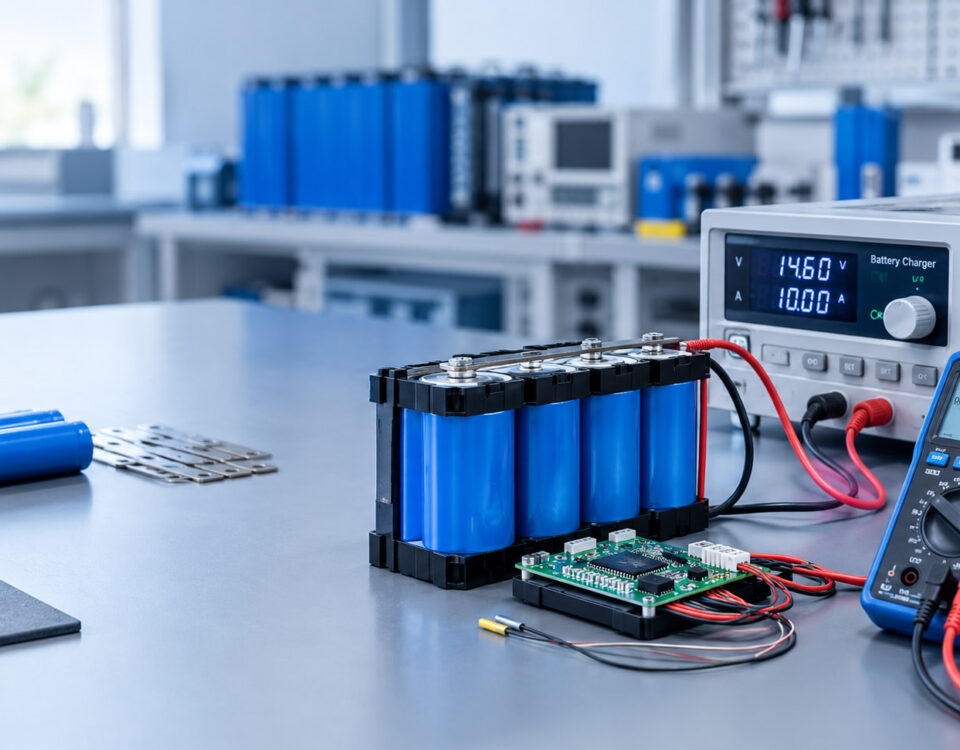
Ан AGV lithium battery typically consists of multiple individual cells connected in series and parallel to achieve the required voltage and capacity. Although these cells are manufactured to similar specifications, their electrical characteristics are never perfectly identical. Differences in internal resistance, capacity, temperature, and aging can gradually develop during operation.
Without proper management, these differences may affect the performance and safety of the entire battery pack.
The BMS continuously collects information from the battery and uses it to make control decisions. It monitors cell voltages, current, temperature, and other operating parameters, then determines whether the battery can safely continue charging or discharging.
In an AGV application, the BMS also communicates with the vehicle controller and charging equipment. This allows the battery to participate in the vehicle’s overall energy management strategy.
In simple terms, the BMS performs three essential roles:
-
Battery monitor: Tracks the electrical and thermal condition of the battery.
-
Safety controller: Prevents operating conditions that could damage cells or create safety hazards.
-
Communication interface: Exchanges battery information with AGV controllers, chargers, and fleet management systems.
These functions work together to improve battery reliability and support continuous industrial operation.
2. Five Essential Functions of an AGV Battery Management System
2.1 Real-Time Battery Monitoring and State Estimation
Continuous monitoring is the foundation of effective battery management.
An AGV BMS collects data from multiple measurement points, including individual cell voltages, total battery voltage, charging and discharging current, and cell or module temperatures.
Using these measurements, the BMS calculates several important battery indicators.
State of Charge (SOC): SOC indicates the remaining available charge in the battery, expressed as a percentage. It helps the AGV controller determine how much operating energy remains and whether the vehicle should return to a charging station.
State of Health (SOH): SOH represents the battery’s overall condition compared with its original performance. It helps maintenance teams identify capacity degradation and evaluate when battery servicing or replacement may be necessary.
State of Power (SOP): SOP estimates how much power the battery can safely deliver or accept under current conditions. This is particularly important when an AGV accelerates, carries heavy loads, climbs ramps, or performs other high-demand movements.
State of Energy (SOE): SOE estimates the remaining usable energy, helping equipment controllers and fleet management systems make more practical operating decisions.
Accurate SOC estimation is especially important for AGVs because LiFePO4 batteries have a relatively flat voltage curve across much of their normal operating range. Voltage alone is therefore insufficient to determine the remaining charge accurately.
Modern BMS designs commonly combine current integration, voltage measurements, temperature compensation, and battery models to improve estimation accuracy.
2.2 Comprehensive Battery Safety Protection
AGVs often operate for extended periods with limited direct human supervision. A battery fault may interrupt production, affect warehouse logistics, or create risks for nearby personnel and equipment.
The BMS provides several layers of electrical and thermal protection.
Overcharge protection: Prevents individual cells from exceeding their specified upper voltage limits during charging.
Over-discharge protection: Stops or restricts discharging when cell voltage approaches the manufacturer’s lower operating limit.
Overcurrent protection: Detects charging or discharging currents beyond permitted limits and activates the appropriate protective response.
Over-temperature protection: Monitors battery temperature and reduces power or disconnects the battery when thermal conditions become unsafe.
Short-circuit protection: Works with appropriately rated fuses, contactors, and electronic protection circuits to interrupt dangerous fault currents.
For industrial AGVs, these functions should also be coordinated with the vehicle controller. For example, if the battery approaches a critical discharge threshold, the BMS can communicate a warning before protective shutdown occurs, allowing the AGV to complete a controlled stop or return to a designated charging location where operating conditions permit.
A properly engineered protection strategy should prevent battery faults from developing into more serious equipment failures.
2.3 Cell Balancing for Longer Battery Service Life
A lithium battery pack contains many individual cells, and even small differences between them can become more significant over repeated charge and discharge cycles.
When cells develop different voltage or capacity characteristics, the weakest cell may reach its upper or lower voltage limit before the others. This can restrict the usable capacity of the entire battery pack.
Cell balancing helps reduce these differences.
Two commonly used balancing methods are passive and active balancing.
-
Passive balancing: Removes excess energy from higher-voltage cells through resistors, converting the excess energy into heat. It is relatively simple and cost-effective.
-
Active balancing: Transfers energy between cells using electronic circuits, allowing surplus energy from stronger cells to support weaker ones. It can improve energy utilization but generally involves greater circuit complexity and cost.
For many industrial аккумулятор для АГВ systems, passive balancing provides a practical solution. Active balancing may be considered where battery capacity, operating requirements, or system economics justify the additional complexity.
Effective cell balancing helps maintain pack consistency, improve usable capacity, and support longer battery service life.
2.4 Temperature Monitoring and Thermal Management
Temperature has a significant influence on lithium battery performance and durability.
AGVs may operate in refrigerated warehouses, unheated loading areas, or manufacturing facilities with elevated ambient temperatures. Their batteries must therefore handle changing thermal conditions throughout the working day.
The BMS continuously monitors battery temperature and applies appropriate operating restrictions.
At low temperatures, charging current may need to be reduced or charging completely prevented until the cells reach an approved temperature. At high temperatures, the BMS may limit discharge power or activate cooling equipment, depending on the system design.
Some advanced AGV battery systems incorporate integrated heating elements, insulation, or other thermal management solutions.
When an AGV returns to its charging station in cold conditions, a temperature-controlled battery may need to preheat before accepting a normal charging current. This protects the cells while making winter operation more predictable.
Thermal management is therefore not simply a protective feature. It is an important part of maintaining consistent battery performance across different operating environments.
2.5 Communication Between the Battery and AGV Control System
An AGV battery does not operate independently. It must exchange information with the vehicle controller, charger, and sometimes the warehouse management or fleet management system.
Communication enables the AGV to obtain real-time battery information and adjust its operating strategy accordingly.
CAN bus is widely used in industrial battery applications because it supports reliable communication between electronic control units. Depending on the equipment architecture, other communication interfaces or protocols may also be required.
Through a suitable communication interface, the BMS can provide information such as:
-
Battery voltage and current.
-
Remaining battery charge and available energy.
-
Cell and battery temperatures.
-
Charging and discharging status.
-
Maximum permitted charging and discharging current.
-
Fault codes and protection warnings.
-
Battery health and operating history.
This information allows the AGV controller to make more informed decisions.
For example, when the battery reports a reduced power capability, the vehicle controller can adjust acceleration or avoid unnecessary high-load operations. When the battery approaches a predefined low SOC threshold, the fleet management system can schedule the vehicle for charging.
Good communication between the battery and vehicle is essential for intelligent energy management.
3. Why AGV Applications Place Higher Demands on BMS Performance
Although the basic functions of an AGV BMS are similar to those used in other lithium battery applications, industrial automation creates several additional challenges.
Frequent Charging and Opportunity Charging
Many modern AGVs operate using opportunity charging. Instead of waiting until the battery is nearly empty, vehicles recharge during short breaks, loading intervals, or scheduled idle periods.
This operating model requires the BMS to coordinate closely with the charger and support frequent charging cycles within the cell manufacturer’s permitted operating limits.
Charging current, battery temperature, SOC, and charging time must all be considered. An intelligent BMS helps prevent unsuitable charging conditions while supporting more efficient use of available charging windows.
High-Frequency Start-Stop Operation
Unlike applications with relatively stable power consumption, AGVs frequently accelerate, decelerate, turn, stop, and restart.
These changes create fluctuating current demands. A battery may experience brief high-current peaks even when its average power consumption is relatively modest.
The BMS must therefore be designed around both continuous and peak current requirements.
Its power estimation and protection settings should reflect the actual AGV duty cycle rather than relying solely on nominal battery capacity.
Multi-Shift and Continuous Operation
Large warehouses and automated production facilities may operate around the clock.
In these environments, battery reliability directly affects fleet utilization. Unexpected battery shutdowns, inaccurate SOC readings, or communication failures can interrupt automated workflows.
A suitable BMS should provide dependable monitoring, fault diagnostics, and predictable battery behavior throughout repeated operating cycles.
Limited Installation Space
AGVs often have compact chassis designs, leaving limited room for battery packs and electronic components.
The BMS must therefore be compatible with the battery’s electrical architecture, mechanical dimensions, wiring arrangement, and heat dissipation requirements.
A well-integrated design reduces unnecessary installation complexity while supporting convenient maintenance and reliable operation.
4. Advanced BMS Features for Next-Generation AGVs
As warehouse automation develops, BMS technology is moving beyond basic monitoring and protection toward more intelligent battery management.
Several capabilities are becoming increasingly valuable.
Predictive fault diagnosis: By analyzing voltage differences, temperature trends, current behavior, and historical fault records, advanced systems can help identify developing battery abnormalities before they cause operational interruptions.
Data logging and maintenance analysis: Recording charging cycles, operating temperatures, current peaks, and protection events provides useful information for evaluating battery performance and planning maintenance.
Intelligent charging coordination: The BMS can communicate charging limits and battery conditions to compatible chargers, helping optimize charging performance without exceeding cell operating restrictions.
Cloud-based monitoring: When integrated with suitable communication gateways and fleet management platforms, battery information can be collected remotely. Fleet operators can review battery status, identify abnormal vehicles, and compare energy consumption across different AGVs.
Improved energy prediction: More advanced battery algorithms can combine SOC, SOH, temperature, and operating history to estimate available energy more accurately. This information can help fleet systems schedule charging and vehicle assignments more efficiently.
These capabilities make the BMS an important component of the broader industrial automation ecosystem.
5. How to Choose the Right BMS for an AGV Battery
Selecting a suitable BMS requires more than checking whether it supports a particular battery voltage.
AGV manufacturers and system integrators should evaluate the following factors.
Battery chemistry and configuration: Confirm compatibility with the selected LiFePO4 cells, series and parallel configuration, and rated voltage.
Current requirements: Check continuous and peak discharge current, charging current, and protection thresholds against the AGV’s real operating conditions.
Communication compatibility: Verify that the BMS supports the communication protocol and data format required by the vehicle controller and charging equipment.
Charging strategy: Consider whether the AGV uses conventional charging, automatic charging stations, or opportunity charging.
Environmental adaptability: Evaluate operating temperature limits, enclosure protection, vibration resistance, and electrical connection reliability.
Safety and fault handling: Confirm that the BMS includes appropriate voltage, current, and temperature protection, along with reliable fault reporting and system-level shutdown functions.
Customization capability: Different AGVs have different battery dimensions, voltage requirements, connectors, and control architectures. A BMS that can be configured for the specific application can simplify integration and improve overall system compatibility.
A carefully selected BMS should be evaluated as part of the complete battery system, rather than as an isolated electronic component.
6. RICHYE: Intelligent Battery Solutions for AGV and Industrial Applications
В качестве литиевая батарея system developer and manufacturer, RICHYE focuses on providing application-oriented battery solutions for industrial equipment.
For AGV and AMR applications, battery performance depends on the coordination of cells, BMS, electrical protection, thermal management, and communication with the vehicle.
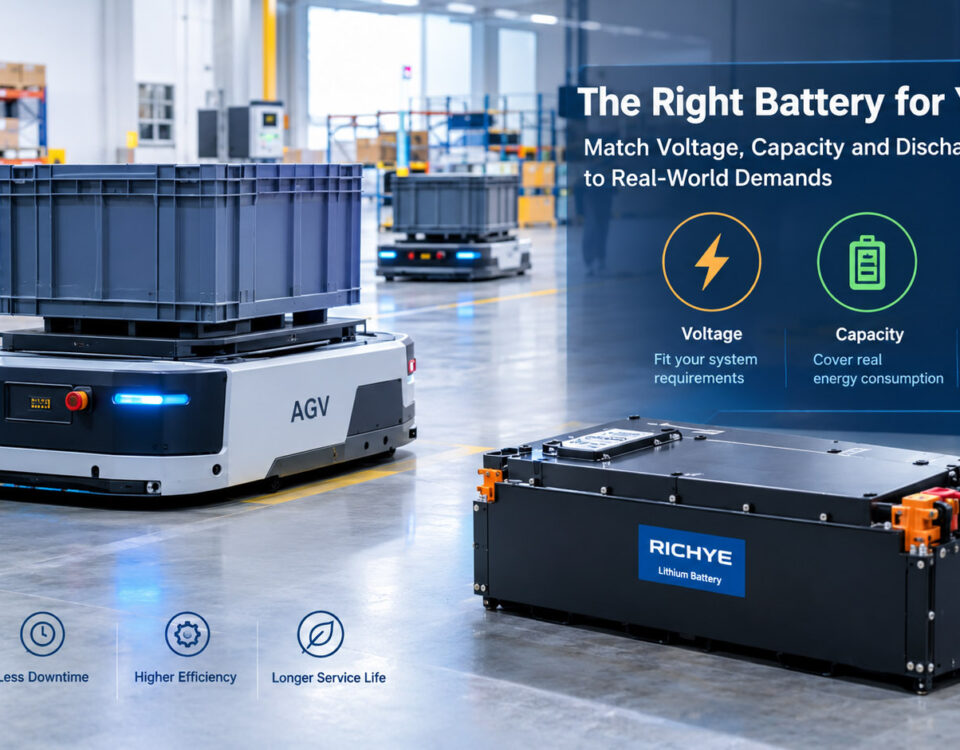
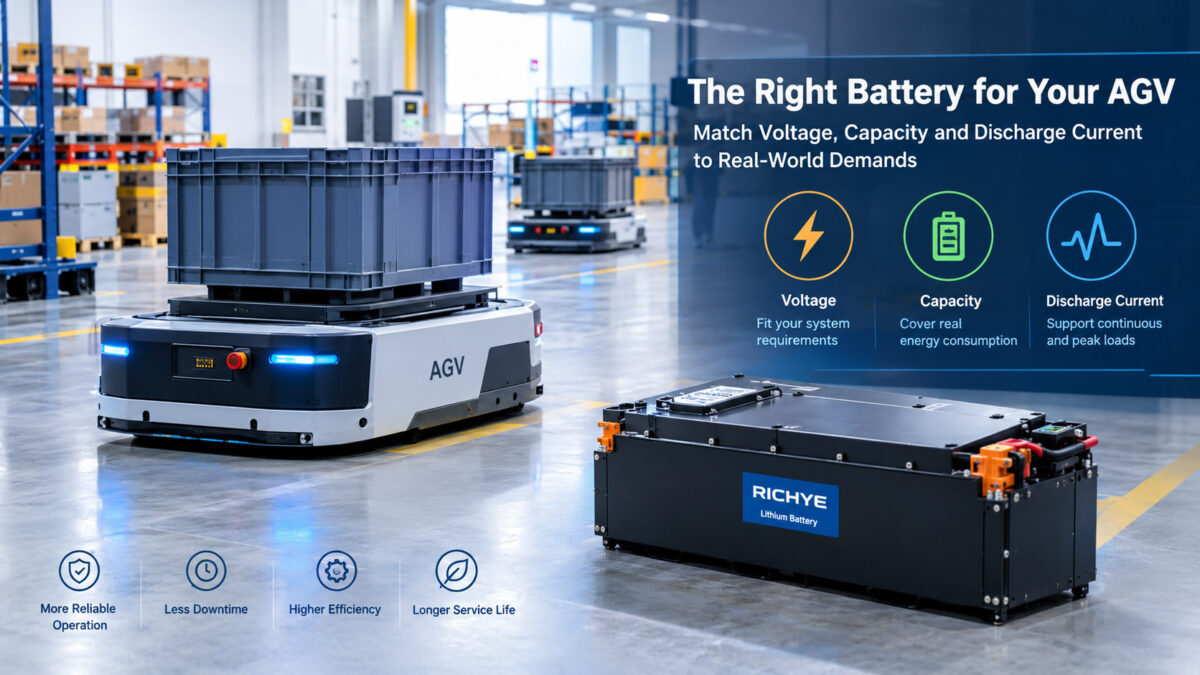
RICHYE battery systems can be configured around application-specific requirements, including operating voltage, capacity, discharge current, charging strategy, communication interfaces, and installation dimensions.
This approach is particularly important for automated warehouses and manufacturing environments, where different vehicles may have significantly different operating cycles and energy demands.
Beyond AGVs and AMRs, industrial lithium battery applications also include electric forklifts, golf carts, and aerial work platforms. Each application requires a different balance of energy capacity, power output, charging performance, and system integration.
By considering the complete operating environment during battery system development, equipment manufacturers can build more reliable power solutions that support long-term operational requirements.
Conclusion: A Smarter BMS Means a More Reliable AGV
A Battery Management System is much more than a protective circuit inside a lithium battery pack. For AGVs, it is a critical control component that influences battery safety, available power, charging efficiency, service life, and overall equipment availability.
From real-time monitoring and cell balancing to thermal management, fault diagnosis, and communication with vehicle controllers, every BMS function contributes to the reliability of an automated material-handling system.
As warehouses move toward higher levels of automation and continuous operation, the importance of intelligent battery management will continue to grow.