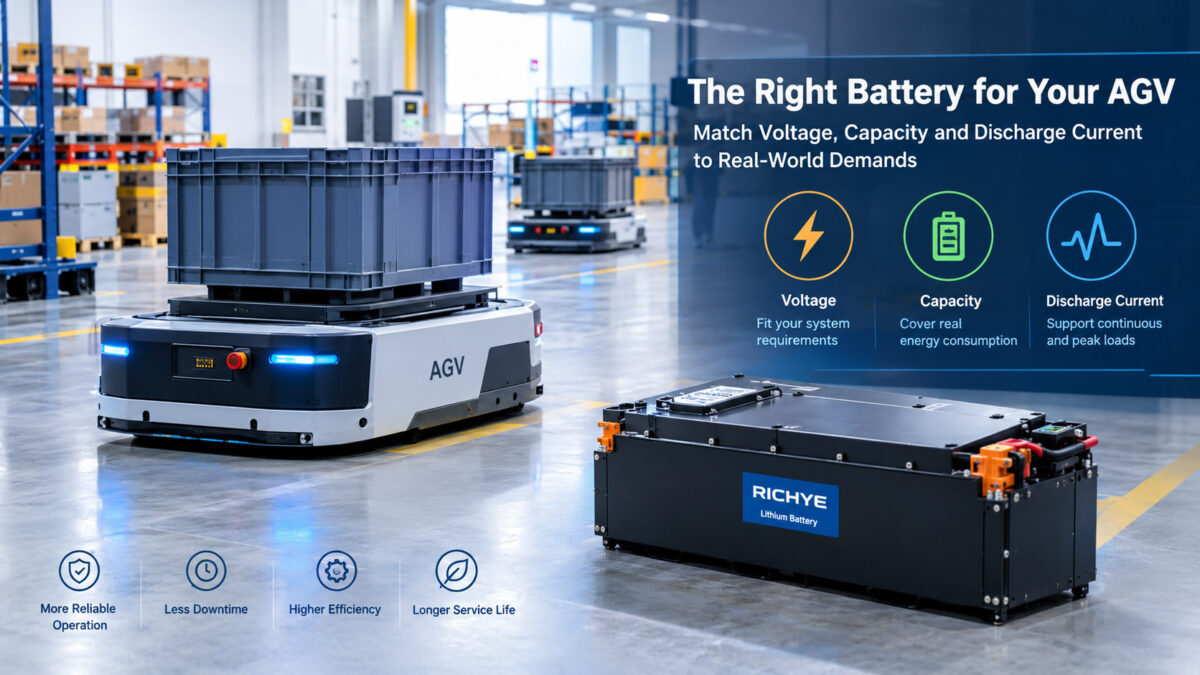


A Practical Engineering Guide to Preventing Power Shortages, Reducing Downtime, and Building More Reliable Automated Guided Vehicles
Selecting a battery for an automated guided vehicle (AGV) involves more than choosing a voltage rating or a large amp-hour capacity. A battery may provide enough energy for several hours of operation yet fail to deliver the current required during acceleration. Another may meet the vehicle’s initial runtime requirements but struggle to complete a full shift as its capacity gradually declines.
These problems often originate during the design stage, when voltage, capacity, discharge current, and operating conditions are evaluated separately rather than as parts of one electrical system.
For AGV manufacturers, system integrators, and fleet operators, the goal is to specify a battery that delivers sufficient energy, supports demanding power loads, and remains reliable throughout its intended service life. RICHYE explains the essential calculations and practical considerations behind a well-matched AGV battery system.
1. Start with the AGV’s Electrical Architecture
Battery selection should begin with the vehicle’s electrical requirements, not with a preferred battery capacity.
The motor controller, traction motors, lifting mechanisms, onboard computers, sensors, communication modules, and other auxiliary equipment all influence the battery specification. Before comparing battery options, establish the vehicle’s nominal system voltage, permitted voltage range, average power consumption, maximum current demand, and available installation space.
Common AGVバッテリー voltage classes include 24V, 36V, 48V, and 72V, although the appropriate configuration depends on the vehicle design and application.
A 24V system may suit a compact AGV with relatively modest power requirements. A 48V system may be appropriate for a larger material-handling vehicle, while higher-voltage architectures can support applications requiring greater power transfer. These are general examples, not universal rules: the motor controller and other connected components determine which voltage range is acceptable.
The most important principle is to match the battery voltage to the complete electrical system. Increasing voltage simply because it appears more powerful is not a safe or reliable upgrade strategy. Any change must account for controller limits, component ratings, charging requirements, protection devices, and communication interfaces.
2. Calculate Battery Capacity from Actual Energy Consumption
Battery capacity, expressed in amp-hours (Ah), indicates how much charge a battery can store. However, Ah alone does not tell you how much energy the battery can deliver over a working shift.
For a more meaningful comparison, calculate energy in watt-hours (Wh) or kilowatt-hours (kWh).
The basic formula is:
Energy consumption (Wh) = Average power consumption (W) × Operating time (h)
For example, consider an AGV that consumes an average of 600W over an eight-hour shift.
600W × 8h = 4,800Wh, or 4.8kWh.
This is the estimated energy requirement before accounting for battery operating limits, aging, temperature effects, and design reserves.
To convert the energy requirement into an approximate battery capacity, use:
Battery capacity (Ah) = Required energy (Wh) ÷ Nominal battery voltage (V)
For a 48V battery, the calculation becomes:
4,800Wh ÷ 48V = 100Ah.
However, a 48V, 100Ah battery stores approximately 4.8kWh of nominal energy. It does not necessarily provide the full 4.8kWh as usable energy under every operating condition.
If the design assumes that only 80% of nominal energy should be used during normal operation, a 100Ah battery would provide approximately 80Ah of usable capacity under that simplified assumption. Actual usable energy depends on the battery chemistry, discharge limits, temperature, load profile, and BMS configuration.
The calculation must therefore be adjusted to reflect the intended operating window.
Account for Aging and Operating Reserves
A new battery does not retain its original capacity indefinitely. Repeated cycling, temperature exposure, and time gradually reduce the energy available for operation.
Suppose an AGV needs 4.8kWh of usable energy per shift. If the design must still meet this requirement when the battery has declined to 80% of its original capacity, and normal operation is limited to 80% of the available nominal capacity, the simplified nominal energy requirement becomes:
4.8kWh ÷ (0.80 × 0.80) = 7.5kWh.
At a nominal voltage of 48V, this corresponds to approximately 156Ah.
This is an illustrative sizing calculation rather than a universal specification. The assumed 80% operating window and 80% end-of-life capacity must be verified against the selected battery’s performance data and the application’s service requirements.
The lesson is straightforward: size the battery for the required operating performance over its intended service life, not just for the first few months after installation.
3. Understand Why Discharge Current Matters as Much as Capacity
Capacity determines how much energy is stored. Discharge current determines how quickly that energy can be delivered.
An AGV rarely operates at a constant power level. Current demand can increase sharply when the vehicle accelerates, climbs a ramp, carries a heavy load, starts a lifting mechanism, or changes direction repeatedly.
The approximate relationship between electrical power, voltage, and current is:
Current (A) = Power (W) ÷ Voltage (V)
For example, a 48V AGV drawing 1,200W requires approximately 25A under idealized nominal-voltage conditions.
If its power demand rises to 2,400W, the corresponding current increases to approximately 50A.
Actual battery current may be higher because of conversion losses and voltage drop, and the calculation should use the relevant operating voltage rather than assuming the nominal voltage remains constant.
A battery rated at 100Ah does not automatically support every discharge current that the vehicle may demand. Its allowable continuous and peak currents depend on cell capabilities, thermal conditions, interconnections, and BMS limits.
When specifying an AGVバッテリー, distinguish between three requirements:
-
Continuous discharge current: The current the battery must sustain during normal operation without exceeding its electrical or thermal limits.
-
Peak discharge current: The higher current required during acceleration, lifting, or other demanding events, together with the duration and frequency of those events.
-
Repeated transient loads: Short bursts that occur frequently enough to influence battery heating, voltage stability, and long-term performance.
A battery that can tolerate a brief current peak may not be suitable for repeated peaks throughout a demanding shift. Both current magnitude and duration must be evaluated.
4. Use C-Rate to Compare Battery Discharge Capability
The C-rate expresses charge or discharge current relative to the battery’s rated capacity.
For a 100Ah battery, a 1C discharge rate corresponds to 100A. A 0.5C rate corresponds to 50A, while a 2C rate corresponds to 200A.
This makes C-rate useful when comparing batteries of different capacities, but it should never replace checking the manufacturer’s actual current ratings.
Consider two 48V battery options, each rated at 100Ah. Both have approximately 4.8kWh of nominal energy. However, one may support a continuous discharge current of 50A, while the other may be designed for 100A continuous discharge.
Their stored energy is similar, but their suitability for a high-power AGV may differ significantly.
If a vehicle requires 80A continuously during a particular operating mode, the first battery would not meet that requirement, even though its capacity and voltage appear correct. The second may be suitable if its discharge limits, thermal performance, peak-current capability, and system interfaces also satisfy the application.
This is why battery specifications should explicitly identify continuous current, peak current, peak duration, and permitted operating conditions rather than relying on Ah ratings alone.
5. Calculate for the Real Duty Cycle, Not Just Motor Nameplate Power
Motor power ratings are useful starting points, but they do not necessarily represent the AGV’s average energy consumption.
A vehicle may spend substantial time moving at steady speed, waiting at a workstation, turning, accelerating, lifting loads, or communicating with warehouse management systems. Each activity contributes differently to total energy demand.
A more accurate assessment divides the operating cycle into representative activities and estimates the energy consumed during each.
例えば:
| Operating activity | Average power | Duration | Energy used |
|---|---|---|---|
| Travel and material handling | 700W | 5h | 3.5kWh |
| Acceleration and turning | 1,200W | 1h | 1.2kWh |
| Lifting and auxiliary operations | 500W | 1h | 0.5kWh |
| Standby and idle periods | 100W | 1h | 0.1kWh |
| Total | - | 8h | 5.3kWh |
This simplified example produces a total energy requirement of 5.3kWh for the shift. It is more informative than multiplying the motor’s maximum rated power by eight hours, which could substantially overestimate consumption, or using a low cruising-power estimate that ignores demanding operations.
Where possible, collect current and voltage data from an AGV operating under representative payloads, routes, floor conditions, and production schedules. Include lifting equipment, onboard electronics, and other auxiliary loads.
The measured duty cycle provides a stronger basis for battery sizing and reduces the risk of purchasing a battery that is either inadequate or unnecessarily large.
6. Check Voltage Drop and the Entire Power Delivery Path
Even when a battery meets its nominal voltage and current specifications, the vehicle may experience unexpected power interruptions.
During high-current operation, voltage drops occur across cells, cables, connectors, fuses, contactors, and other components. Internal battery resistance also contributes to voltage sag.
If the voltage at the motor controller falls below its permitted operating threshold, the AGV may reduce power, trigger a fault, or stop unexpectedly.
For this reason, battery selection must consider the lowest expected operating voltage, not only the nominal voltage printed on the specification sheet.
The complete power delivery system should be checked for:
-
Cable and connector current ratings.
-
Voltage drop under continuous and peak loads.
-
BMS overcurrent thresholds and response behavior.
-
Fuse and contactor ratings.
-
Motor controller undervoltage limits.
-
Heat generation during repeated high-current operation.
A higher-capacity battery does not automatically solve these problems. The system must be designed so that the cells, BMS, wiring, connectors, and vehicle controller operate within compatible limits.
7. Match the Battery to Charging Strategy and BMS Requirements
The way an AGV is charged influences the required battery capacity and its long-term performance.
Vehicles that operate one shift and recharge between shifts may require enough usable energy for the entire shift. Fleets using opportunity charging may be able to operate with a smaller battery if charging windows are sufficiently frequent and long enough to replace the energy consumed.
However, opportunity charging must be supported by the battery, charger, BMS, and vehicle control system. Charging current limits, temperature restrictions, charge acceptance, and communication behavior must all be considered.
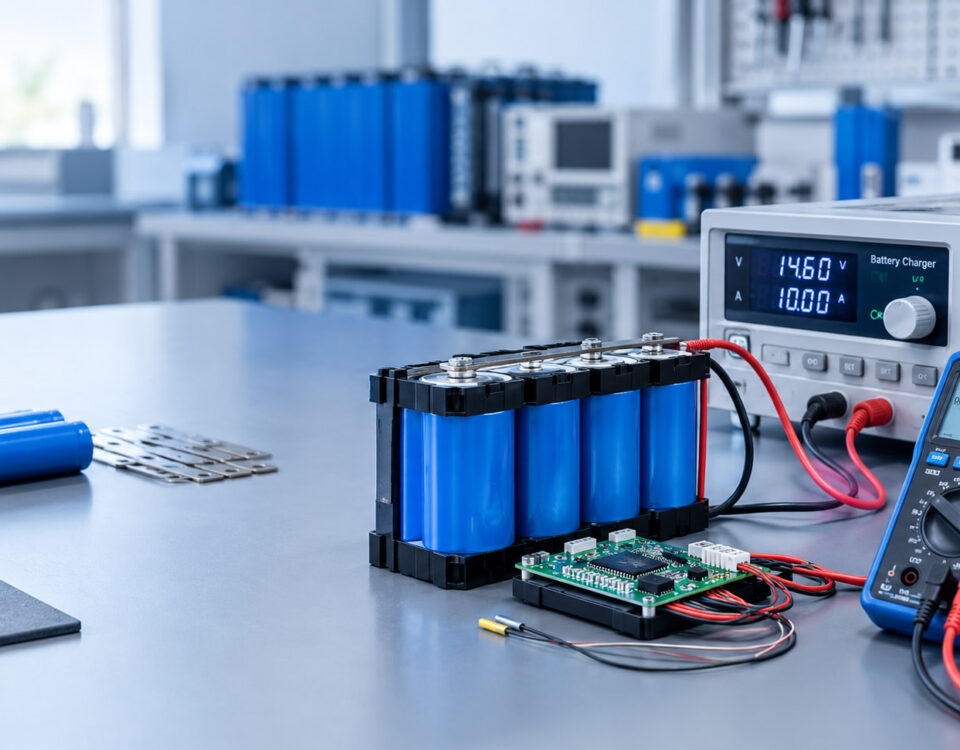
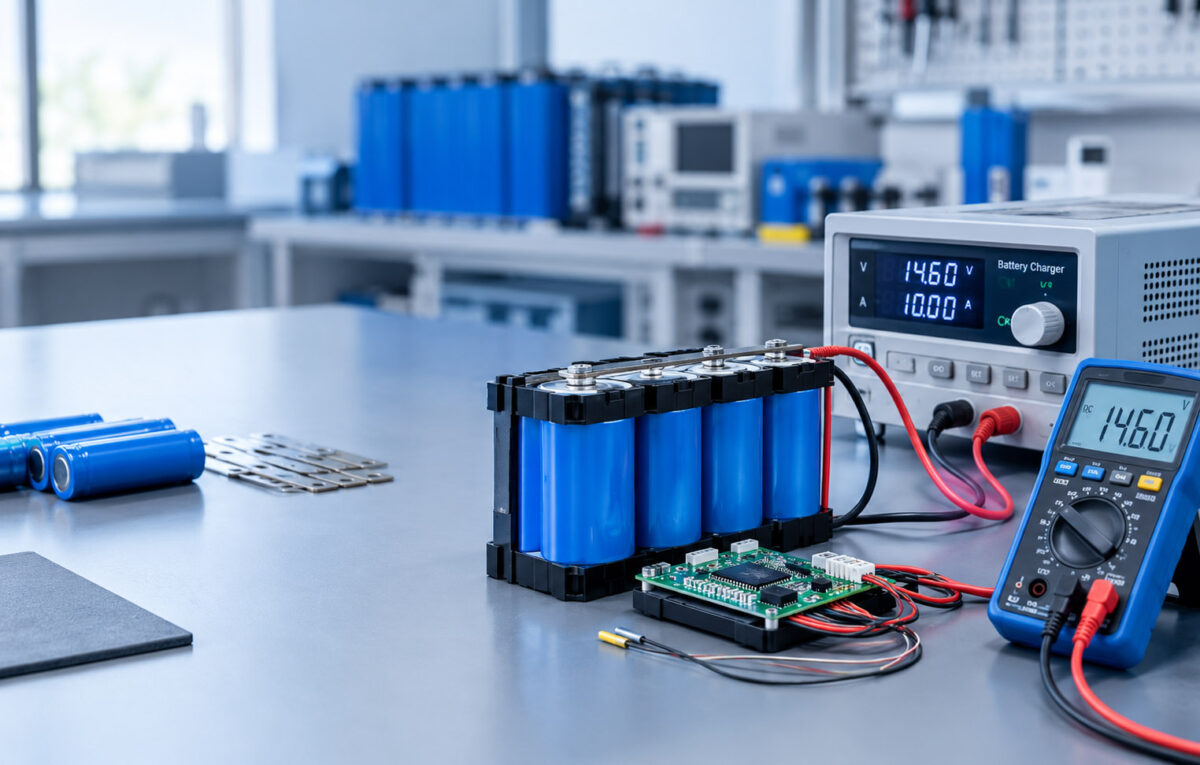
The BMS should provide appropriate protection against overvoltage, undervoltage, overcurrent, and excessive temperature. For applications requiring communication with the vehicle controller or fleet management system, confirm the required protocol and data points, such as state of charge, battery alarms, temperature, and allowable charge or discharge current.
LiFePO₄ batteries are widely considered for industrial AGVs because of their thermal stability and potential for long cycle life. Nevertheless, actual performance depends on cell quality, pack design, operating conditions, and charging practices. Battery chemistry alone cannot guarantee a particular service life or charging speed.
The charger must also match the battery chemistry and pack configuration. A battery designed for one charging profile should not be connected to a charger with incompatible voltage or current settings.
8. Build the Specification Around the Application
Before approving an AGV battery design, confirm that the specification addresses the following requirements:
-
Nominal voltage and permitted operating voltage range.
-
Required usable energy per shift.
-
Rated capacity and the assumptions used to calculate it.
-
Continuous and peak discharge current, including peak duration.
-
Target service life and expected cycling frequency.
-
Charging voltage, maximum charging current, and charging schedule.
-
Operating and charging temperature limits.
-
Maximum battery dimensions and weight.
-
BMS protection functions and communication requirements.
-
Connector, cable, mounting, and enclosure compatibility.
For OEM projects, these details should be established before finalizing the battery design. For replacement projects, the original battery label is useful, but the vehicle controller specifications, charger requirements, and actual duty cycle should also be reviewed before changing voltage or capacity.
結論
Choosing the right AGV battery is an engineering exercise in balancing stored energy, power delivery, system compatibility, and operating life.
Voltage must match the vehicle’s electrical architecture. Capacity must cover real energy consumption across the required operating period. Discharge current must support both continuous loads and short-duration peaks. Charging strategy, voltage drop, temperature, and battery aging then determine whether the selected system will remain dependable in daily operation.
リヒ provides lithium battery solutions for industrial applications, including AGVs and material-handling equipment. By evaluating battery requirements against actual operating conditions and verifying the complete electrical interface, manufacturers and fleet operators can make more informed specifications, reduce avoidable downtime, and build a more reliable foundation for automated material handling.